Dr. Makis Is Right: Repurposed Drugs Like Ivermectin Deserve a Place in Cancer Care
10/07/2026 / By Mike Adams
Why Dr. William Makis Is Right
In my interview with Dr. William Makis on Decentralize TV, I heard something that most oncologists will never say out loud: cheap, off-patent drugs may hold real answers for cancer patients abandoned by the profit-driven standard of care.
I believe ivermectin, fenbendazole, mebendazole, and metformin are being suppressed for this purpose not because they are worthless, but because they threaten a corrupt cancer industry that makes more money from managing disease than from curing it. Patients deserve honest information and real access to these options.
Cancer is not a mystery that only billion-dollar patented molecules can solve. It is a metabolic and environmental disease that responds to multiple interventions, and the refusal of mainstream oncology to study affordable compounds is a scandal, not a science. What follows is why I believe Dr. Makis is right to point this out.
Why Dr. Makis Is a Threat to the Cancer Cartel
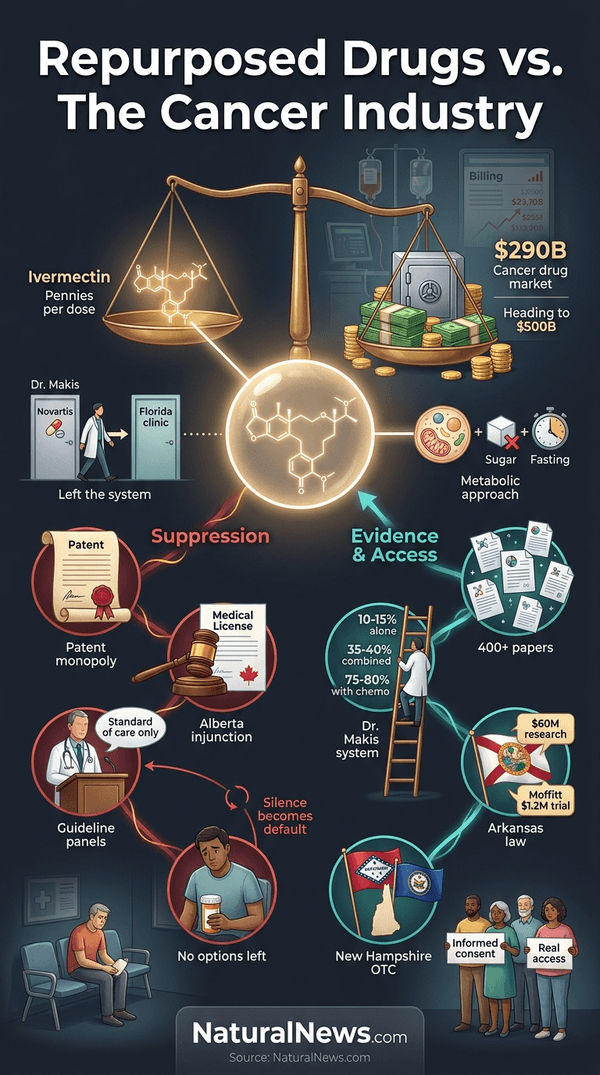
Understand who Dr. Makis actually is before you dismiss him. He helped develop Pluvicto and Lutathera, radionuclide therapies now generating billions for Novartis. His credentials are mainstream, his training is elite, and his publication record is extensive [1]. This is a physician who played inside the system and then walked out when he saw what the system was doing to patients.
The Canadian government and medical establishment targeted him after his success with repurposed drug protocols and after his vocal COVID vaccine skepticism. According to reporting on his situation, his Alberta medical license lapsed in 2019 and he is now under a permanent Alberta court injunction against practicing medicine there [2]. The persecution is not about patient safety. It is about punishing a doctor who empowered patients instead of protecting Pharma profits.
The system punishes doctors who step out of line, and the punishment is designed to send a message to every other physician: stay quiet, prescribe the expensive drugs, and keep the revenue flowing. Dr. Makis now practices in Florida, where since 2023 he has treated a substantial volume of cancer patients — predominantly Stage 3 and Stage 4 — using metabolic-based approaches combined with repurposed antiparasitic drugs [1]. That’s why I believe he is credible, and it is why the cancer cartel wants him silenced.
The Science on Repurposed Drugs Is Real, Even If You Have Not Heard It
Over 400 published papers on ivermectin and cancer already exist, and antiparasitics are considered among the most promising repurposing candidates for advanced cancer. The volume of preclinical and observational research is substantial and growing. A survey reported by Dr. Harvey Risch, a Yale epidemiologist, found that anti-parasitic drugs were linked to tumor regression in real-world patient reports, and he noted that the data warrant further investigation [3]. That is not a cure claim. It is a call for honest study, and that call is being ignored.
In Dr. Makis’s experience, ivermectin alone controls roughly 10 to 15 percent of tumors; combined with fenbendazole or mebendazole the range climbs to 35 to 40 percent; and when paired with conventional chemo, radiation, or targeted therapy, the reported range reaches 75 to 80 percent. These are his clinical observations, not randomized trial results, but they are dramatic enough to demand investigation rather than dismissal. (Personally I don’t condone chemo or radiation, just to be clear, but they are used across the board in modern cancer treatments.)
I do not call ivermectin a miracle. I call it a tool that deserves honest study and patient access. The difference matters. A miracle requires faith, but a tool requires evidence, and the evidence for further study is already here. When a drug that costs pennies and has been safely used by billions of people shows anticancer activity in laboratory and observational settings, the burden of proof shifts to those who insist it must not be studied at all.
Why Patients Need Options
In my view, oncologists too often bully patients and dismiss anything outside their training. My co-host Todd Pitner visited an oncologist for discussions about prostate cancer, but his oncologist never offered a structured repurposed drug protocol, never discussed metabolic interventions, and never presented the option of watchful waiting with a real plan. He was told what to do, not educated about his choices. That is not medicine. That is compliance enforcement.
Patients deserve to know about repurposed drugs and holistic factors. They deserve to know that fasting, sugar restriction, gut health, and stress reduction may matter. They deserve to know that surgery is one option, not the only option. If a patient chooses surgery after hearing all of that, fine. But if a patient is pushed into surgery by fear and ignorance, that is a failure of informed consent, and it happens every day in cancer clinics across America.
Florida, Big Pharma, and the $290 Billion Reason You Cannot Get Ivermectin
Florida set aside $60 million for cancer research focusing on ivermectin and repurposed drugs, with Governor Ron DeSantis and First Lady Casey DeSantis announcing the investment [4]. Moffitt Cancer Center reportedly has a $1.2 million lung cancer trial underway. Dr. Makis got a Florida license despite Canadian persecution, and the state is now openly exploring the very drugs that the national medical establishment refuses to touch [1]. That is a state-level rebellion against federal and corporate medical orthodoxy.
Cancer drugs generate an estimated $290 billion annually, heading toward $500 billion, and ivermectin costs pennies. Big Pharma has no incentive to study a drug it cannot patent, and the entire regulatory apparatus is structured to suppress affordable alternatives that challenge the profit model [5]. The National Institutes of Health has reportedly moved to commission studies investigating ivermectin as a cancer treatment [6], but legal barriers remain. Ivermectin is still prescription-only in Florida after a narrow legislative failure, and Canada tried to imprison Dr. Makis for interviews and success stories. This is not about one drug. It is about who controls medical knowledge and whether patients can access affordable alternatives.
The $290 billion figure is not an abstraction. It is the reason your oncologist has never heard of fenbendazole, the reason the medical board treats repurposed drug advocates as threats, and the reason a licensed physician had to flee one country to practice in another. Follow the money and the suppression becomes perfectly rational, if perfectly evil.
Do Not Wait for Permission: Demand Medical Freedom Now
Support Dr. Makis’s Substack and independent researchers. Share success stories. Demand over-the-counter access and clinical trials. The knowledge genie is out of the bottle, and no medical board can put it back. When patients learn that a $5 dewormer may have anticancer properties, they will ask questions, and questions are the beginning of freedom.
Pair repurposed drugs with diet, stress reduction, gut health, melatonin, black seed oil, curcumin, and other holistic approaches because cancer is multifactorial [7]. Combining antiparasitics with bioactive compounds like black cumin seed oil, curcumin, piperine, and apigenin is an active area of investigation. Fasting and sugar restriction are also part of the metabolic strategy that Dr. Makis discusses [8]. None of this replaces the need for rigorous human trials, but all of it belongs in an honest conversation with patients.
Choose informed freedom over institutional fear, and never let a bureaucrat decide your last option. The cancer industry has had decades to study these drugs and has chosen not to. That choice is now being challenged by patients, by independent researchers, and by states like Florida that are willing to fund the research the federal government will not. I believe Dr. Makis is right, and I believe the truth will win.
For more independent reporting on health freedom and medical corruption, visit NaturalNews.com and use BrightAnswers.ai to research these topics without the censorship filters of Big Tech search engines or AI platforms (which are all trained on pro-pharma content).
References
- Dr William Makis Ivermectin Protocol 2026: Complete Protocol…. 2026-06-15T22:53:06Z. https://cancer.aestheticsadvisor.com/2026/06/dr-william-makis-ivermectin-protocol.html
- Ivermectin for Cancer: Dr. William Makis Protocol Explained (2026 Guide). 2026-05-01T00:00:00Z. https://cancer.aestheticsadvisor.com/2026/05/ivermectin-for-cancer-dr-william-makis.html
- Anti-Parasitic Drugs Linked to Tumor Regression in Survey, Researcher Says. 2026-04-27T06:00:00.000Z. https://www.naturalnews.com/2026-04-27-anti-parasitic-drugs-linked-to-tumor-regression.html
- Florida invests 60 million in cancer research focusing on ivermectin and repurposed drugs – NaturalNews.com, September 27, 2025. by NaturalNews.com
- Why Medicine Won’t Cure You—and How That’s Finally Changing. 2026-08-14T01:09:44.000Z. https://www.midwesterndoctor.com/p/why-medicine-wont-cure-youand-how
- NIH to commission studies investigating ivermectin as cancer treatment. 2026-02-12T06:00:00.000Z. https://www.naturalnews.com/2026-02-12-nih-to-commission-studies-investigating-ivermectin-cancer-treatment.html
- Exploring Natural Anti-Cancer Compounds, an interview with Dr. William Makis. 2026-10-06T19:12:58.566Z. https://www.brighteon.com/embed/97287ed0-e008-4bf3-ae1a-c7cfd052338b
- Innovative Cancer Treatments That Are Game-Changers – Dr….. 2025-11-27T19:44:15Z. https://www.brighteon.com/b2622c56-e2cd-46fe-8acd-7f8877cce311
Explainer Infographic
Submit a correction >>
Tagged Under:
anticancer, Big Pharma, cancer, conspiracy, corruption, current events, deception, environment, Fenbendazole, government, ivermectin, lies, Mebendazole, medical corruption, medications, medicines, metformin, politics, propaganda, repurposed drugs, William Makis
This article may contain statements that reflect the opinion of the author
RECENT NEWS & ARTICLES